Senior Design Project 2012-2013
Hops Baler Project
Hops Baler Project
Created by: Jacob Speed, Matt Gallagher, Sam Ledue, Lloyd Bryant, and Nathan Rocker
Size of Bag Chamber and Bale
Benefits of Construction
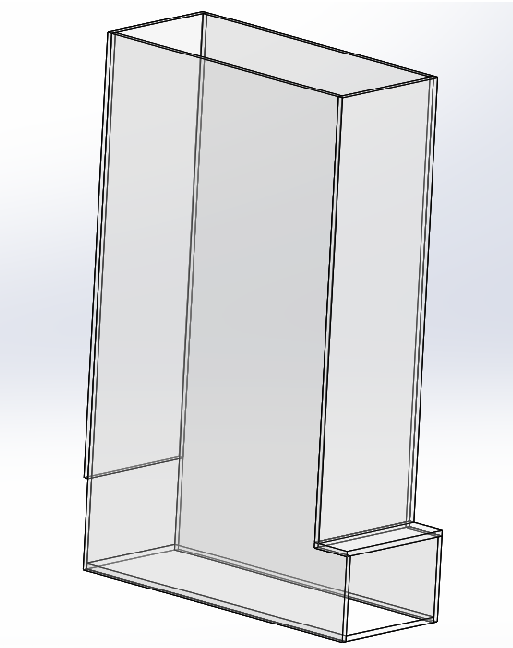
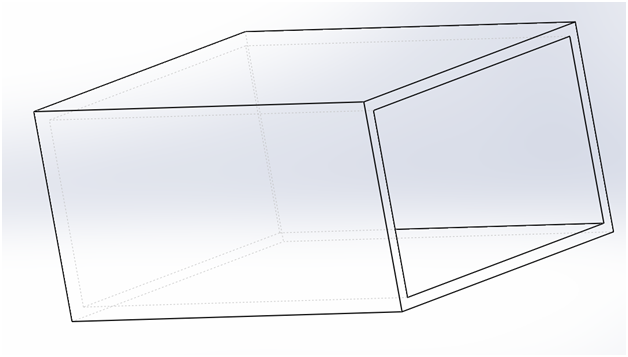
The owners of the small farm suggested that they would like 10-pound bales as a final product. Due to maximum size restricted to only 9.5 inches wide by 5 inches tall, the bale would be doubled in length to meet their goal. We determined the hops could be compressed 14:1 and hold the compression without trying to return to their original shapes. At a 14:1 compression volume ratio, the final 5-pound bale length is 14.5 inches. If this same compression volume ratio was used for a 10-pound bale, the length would be doubled. Not only would the final length need to be doubled, but the compression chamber dimensions would also have to be increased. This increase in overall dimensions exceeds the farms working area, making the decision from a 10-pound bale to a 5-pound bale reasonable.
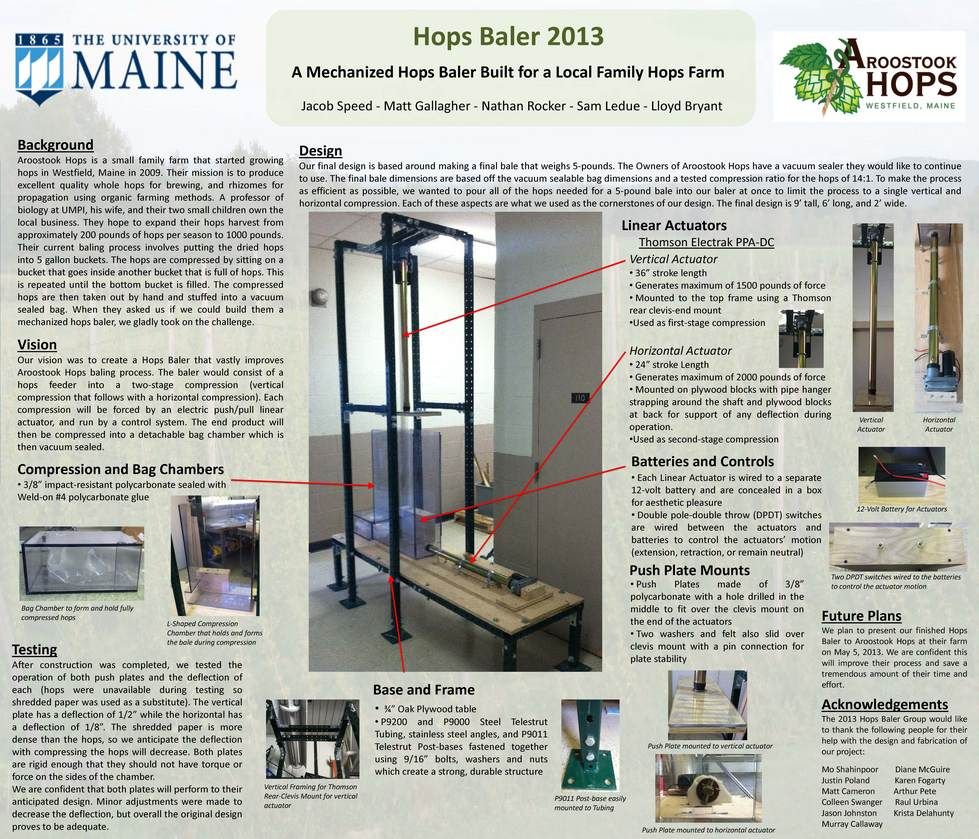
We wanted to design a Hops Baler to allow the operator to pour in a specific volume of hops, flip a few switches, and within 2 minutes come out with a 5-pound bale compressed into the exact vacuum sealed bags that Aroostook Hops had been previously using. Aroostook Hops had recently bought a very expensive vacuum sealer that they wanted to continue to be able to use, so we designed the final bale with the dimensions of their vacuum-sealed bags. We also wanted to minimize the time it took for our Hops Baler to produce a final bale. To do this we designed the Hops Baler so the full volume of hops needed to complete a 5-pound bale could be added to it at once. Another main goal of ours was to increase the weight of the final bale. A 5-pound bale was the largest bale we could produce and still have the dimensions of the baler fit reasonably into the space allotted for it at Aroostook Hops.
After construction was completed, we tested the operation of both push plates and the deflection of each (hops were unavailable during testing so shredded paper was used as a substitute). The vertical plate has a deflection of 1/2” while the horizontal has a deflection of 1/8”. The shredded paper is more dense than the hops, so we anticipate the deflection with compressing the hops will decrease. Both plates are rigid enough that they should not have torque or force on the sides of the chamber. We are confident that both plates will perform to their anticipated design. Minor adjustments were made to decrease the deflection, but overall the original design proves to be adequate.
Design of Finished Baler
Testing the Product

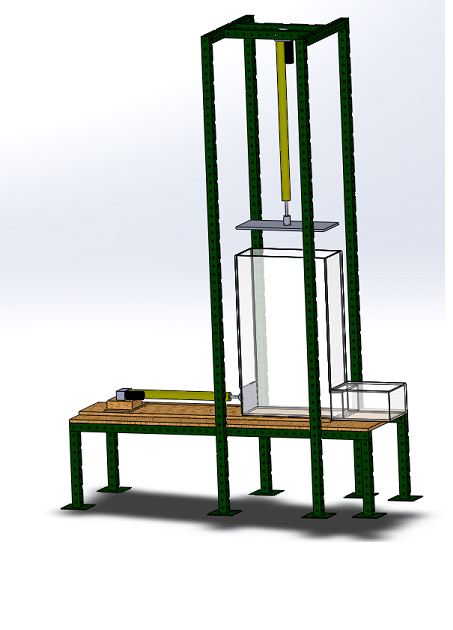
Our final design is based around making a final bale that weighs 5 pounds. The Owners of Aroostook Hops have a vacuum sealer they would like to continue to use. The final bale dimensions are based off the vacuum sealable bag dimensions and a tested compression ratio for the hops of 14:1. To make the process as efficient as possible, we wanted to pour all of the hops needed for a 5 pound bale into our baler at once to limit the process to a single vertical and horizontal compression. Each of these aspects is what we used as the cornerstones of our design. The final design is 9’ tall, 6’ long, and 2’ wide.
Final Design
SolidWorks Model
SolidWorks Model
Compression Chamber
SolidWorks Model
SolidWorks Model
Bag Chamber
SolidWorks Model
SolidWorks Model
Final Presentation/Poster
Hops Baler 2013
Hops Baler 2013